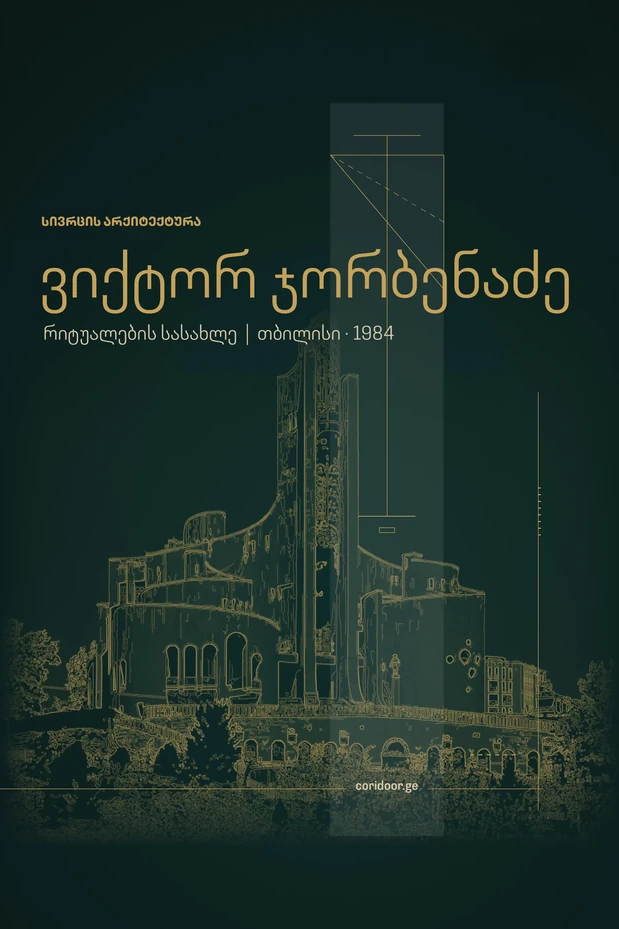
Victor (Butsa) Djorbenadze (1925–1999) is one of the most original and, at the same time, one of the most forgotten names in 20th-century Georgian architecture. Most residents of Tbilisi know his main work — the Palace of Rituals in Avlabari, on the high bank of the Mtkvari River. With its tower and apses, this stone building looks at first glance like a medieval cathedral, yet it was built in the 1980s, during the Soviet era. Far fewer people know who its author was.
All of Tbilisi knew Djorbenadze as “Butsa”, and because of his admiration for Le Corbusier he was also called “Djorbusier”. He was an architect who studied old Georgian churches at his own expense, a close friend of Sergei Parajanov, and someone who, under the conditions of Soviet ideology, managed to build a building that he himself called a “cathedral”.
In this article we look at Butsa Djorbenadze’s biography, his main buildings, the history of the Palace of Rituals and the principles that remain relevant for today’s interiors and architecture.
Butsa Djorbenadze — Quick Facts
| Full name | Victor Djorbenadze, nicknamed “Butsa” |
| Born | 1925, Kharkiv (some sources give 1924 and Tbilisi) |
| Died | 1999, Tbilisi |
| Education | Georgian Polytechnic Institute, Architecture (1940–1946) |
| Main place of work | “Tbilkalakproekti” (from 1959) |
| Best-known work | Palace of Rituals, Tbilisi (1979–1984, together with Vazha Orbeladze) |
| Other buildings | Mukhatgverdi Ritual Complex (1974); Ilia Chavchavadze Museum in Kvareli (1979) |
| Buried | At Mukhatgverdi Cemetery — in the complex he designed himself |
Childhood: From Kharkiv to Samtredia
According to the English-language Wikipedia, Victor Djorbenadze was born on 28 July 1925 in Kharkiv, where his father was serving in the Red Army. Some Georgian sources, including the online directory “Graves of Good Georgians”, give 1924 as the year of his birth and Tbilisi as the place — an inaccuracy that also reflects how fragmentary his biography is.
In 1928 the family moved to Samtredia, where his mother, Lyubov Sanadze, was a leading obstetrician-gynecologist. Butsa’s childhood was privileged for its time: private tutors taught him music and foreign languages. It was this education that later allowed him to read European architectural literature in French and German — an extremely rare advantage for an architect living behind the Iron Curtain.
Education and the Moscow Years
From 1940 to 1946 Djorbenadze studied in Tbilisi, at the Faculty of Architecture of the Georgian Polytechnic Institute. After graduating, he worked for several years in Samtredia, in the design and construction department of the Ministry of Agriculture.
From 1952 to 1956 he worked in Moscow, at the urban planning design institute “Giprogor”, in the studio of the experienced architect Mikhail Parusnikov. The Moscow years introduced him to the inner workings of the Soviet architectural system. His interests, however, went further — towards European modernism and, above all, towards the medieval architecture of his own country.
Return to Tbilisi and the Study of Monuments
In 1957, during Khrushchev’s “Thaw”, Djorbenadze returned to Tbilisi and became chief architect of the Kalinin district. From 1959, for the rest of his career, he worked at the city design institute “Tbilkalakproekti”.
Alongside his official work, Djorbenadze was a devoted researcher of Georgia’s historical monuments. He travelled around the country at his own expense, documenting old churches and buildings. In 1958 he published an essay on Mtskheta as an architectural ensemble, and later carried out scholarly research on Jvari Monastery in Mtskheta, Svetitskhoveli and Bebristsikhe. The study of the proportions of the Jvari church was one of his main academic interests.
He actively spoke out for the protection of historical buildings — at a time when the old city often fell victim to “development”. It was this deep knowledge that became the foundation of his future buildings: Djorbenadze did not use Georgian tradition as superficial ornament, but proceeded from its spatial and structural logic.
“Djorbusier”: Le Corbusier’s Georgian Disciple
Djorbenadze’s favourite architect was the Swiss-French modernist Le Corbusier. Because of his admiration for him, his Tbilisi colleagues jokingly nicknamed him “Djorbusier”. While travelling in India, Djorbenadze made a point of visiting Chandigarh — the city designed by Le Corbusier.
The strongest influence on him came from Le Corbusier’s late work, the Ronchamp chapel (Notre Dame du Haut, 1954) — a sculptural, organic building that breaks the strict rules of modernism. Djorbenadze combined this influence with Georgian church architecture. The result was an entirely new language, which was neither a direct copy of modernism nor a nostalgic imitation of old cathedrals.
The Architectural Context of Soviet Tbilisi
To better understand Butsa Djorbenadze’s work, the context of the era matters. From the mid-1950s, Stalinist neoclassicism in the Soviet Union was replaced by standardized, industrial construction: thousands of identical residential blocks, standard designs, minimal individuality. Within this system it was very difficult for an architect to preserve a personal signature.
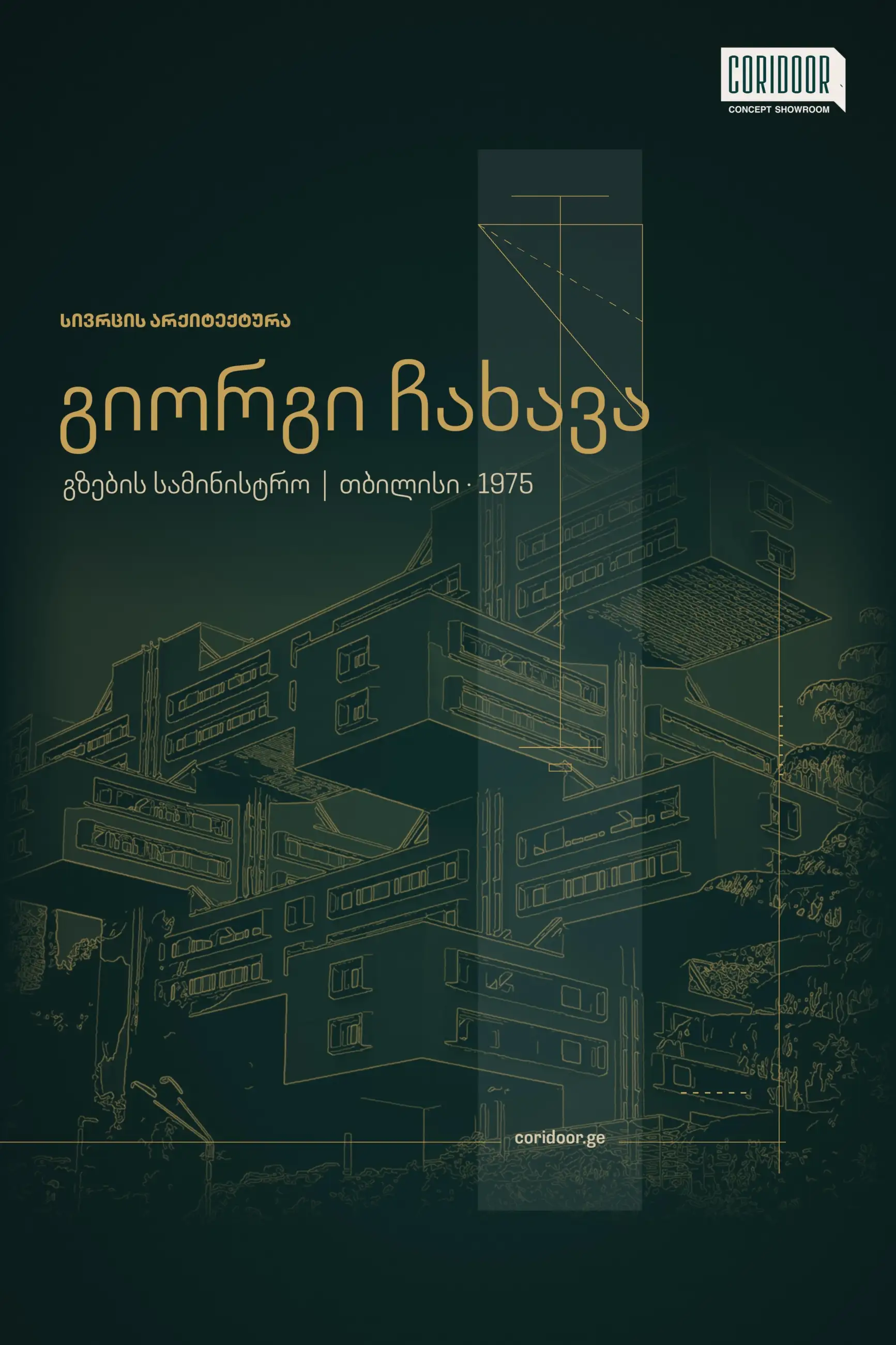
Against this background, Georgia turned out to be an exception. In the 1970s and 80s, several buildings were built in Tbilisi that are today cited in international architectural publications as the finest examples of Soviet modernism: Giorgi Chakhava’s Ministry of Highways (1975), Shota Kavlashvili’s Archaeology Museum in Dighomi and, of course, Djorbenadze’s Palace of Rituals. Authors of The Calvert Journal attribute the possibility of these experiments to the comparatively greater freedom of Georgia at the time.
Djorbenadze’s role in this group is special: while some of his colleagues followed the path of brutalism and structural experiments, he was bringing the memory of Georgian church and residential architecture back in a contemporary form.
Mukhatgverdi Ritual Complex (1974)
Djorbenadze’s first independent commission was a ritual complex on the outskirts of Tbilisi, at the new Mukhatgverdi cemetery. Completed in 1974, the complex sits on a ridge above the Mtkvari valley, from which the old churches of Mtskheta can be seen.
The complex consists of four buildings: the cemetery office, a water tower, a stonemasons’ workshop and a ritual hall. According to The Calvert Journal, each building echoes some aspect of the Ronchamp chapel. Medieval Georgian gravestones are set into the textured plaster — the past enters directly into the body of the new building.
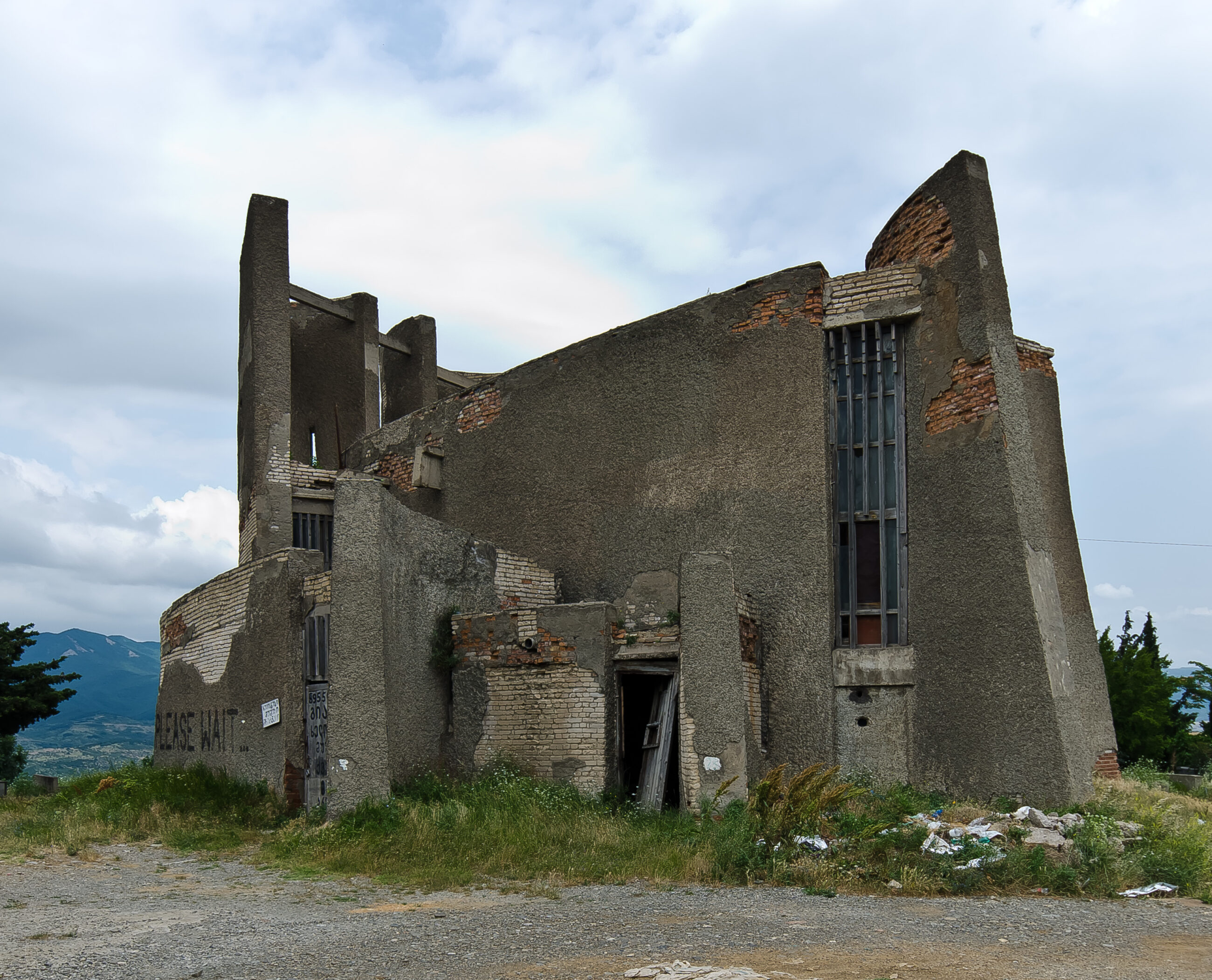
It is symbolic that in 1999 Djorbenadze was buried at Mukhatgverdi — in the complex with which his independent work began.
Ilia Chavchavadze Museum in Kvareli (1979)
After Mukhatgverdi, Djorbenadze, together with architect Keta Kobakhidze, designed a museum in Kvareli, Ilia Chavchavadze’s birthplace. Completed in 1979, the building is a free-standing, spiral-shaped volume of snow-white plaster. The spiral, as an idea of movement through space, would later return in his main work as well.
The task was difficult: Ilia Chavchavadze, born in Kvareli in 1837, is one of the main symbols of Georgian national identity. A building dedicated to his memory had to be neither pompous nor faceless. Djorbenadze and Kobakhidze created a single, clean form that stands freely against the Kakhetian landscape and does not disrupt the scale of the small town.
Palace of Rituals (1979–1984): A Soviet Cathedral in Avlabari
The Idea and the Commission
In the late 1970s, the Soviet authorities needed a ceremonial space for holding new, non-religious rituals — weddings, celebrations of a child’s birth and public festivities. The building was to be associated with the “Tbilisoba” festival and to give people the splendour of a church — but without religious attributes.
The project was commissioned in 1979. Djorbenadze created it together with Vazha Orbeladze. The leader at the time, Eduard Shevardnadze, fully supported the project. When city commissions objected to its scale, cost and “cathedral-like” form, Shevardnadze defended it. According to The Calvert Journal, he answered the critics with the argument that people love churches.
Architecture
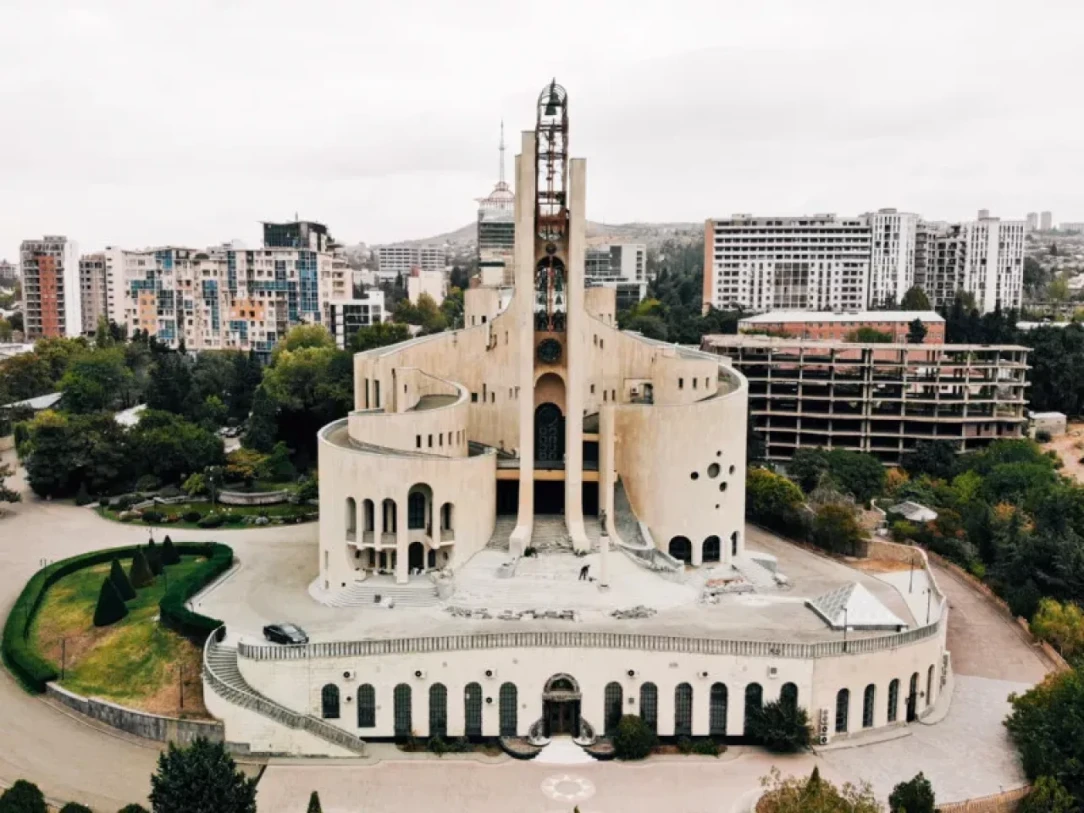
The palace stands on the high bank of the Mtkvari, on Bochorma Street, and became the first significant landmark of what was then an architecturally poor outskirt of the city. The building is clad in warm-toned stone — of the same colour found in medieval Georgian churches. Its silhouette, with a tall tower and rounded apses, recalls at once a Georgian cathedral, the European Expressionism of the 1920s and Le Corbusier’s Ronchamp.
According to the description by Socialist Modernism, the leading theme of the building is its walls, which form spirals. The central space resembles a “medieval square”, while the entrances placed at the corners repeat the streets of the old city. The crown-like roof of the entrance is an interpretation of the traditional Georgian dwelling — the darbazi — and the ceiling of the atrium is based on the idea of the erdo of the darbazi house, only executed in steel.
Darbazi and Erdo: The Memory of the Georgian House
One of the main sources of the Palace of Rituals is the traditional Georgian dwelling — the darbazi. This is a house whose central space is covered by a stepped wooden roof that gradually narrows — the gvirgvini. The opening left at the top of the gvirgvini, the erdo, was at once the smoke outlet and the only source of light: light descended from above, into the centre of the space.
Butsa Djorbenadze transferred this idea to a monumental scale and a contemporary material. The ceiling of the palace atrium repeats the logic of the erdo, only executed in steel instead of wood. This is a precise example of his method: instead of directly quoting a traditional form, he used its principle — the way of organizing space and light.
The Interior: Detail That Unites Everything
The interior of the Palace of Rituals is the best illustration of Djorbenadze’s approach: everything, down to the smallest element, is part of a single concept. There are handmade stained-glass windows, decorative art metalwork and even manhole covers with an image of the building itself embossed on them.
The wall paintings belong to Djorbenadze’s friend and collaborator, the artist Zurab Nizharadze. In one of the frescoes, a lion-headed Djorbenadze holds the palace in the palm of his hand — just as donors (ktitors) in medieval Georgian churches were depicted holding a model of the church. It is a peculiar self-portrait and at the same time a direct dialogue with the tradition of Georgian art.
Criticism and Recognition
The building received mixed reviews. Criticism was provoked by its scale, its cost and Djorbenadze’s persistent wish to call the building a “cathedral”. In 1987 the journal “Literary Georgia” published both a critical article and his letter in response. Some critics even saw in the building’s plan the symbolism of the union of male and female principles — an idea logical for a wedding palace, though one that remained at the level of interpretation.
The palace opened in 1984, during the “Tbilisoba” festival. It quickly became one of the best-known buildings in Tbilisi: in 1987 British Prime Minister Margaret Thatcher watched Georgian dancing here, and in 1990 Deep Purple vocalist Ian Gillan renewed his wedding vows here.
The Palace’s Later Fate
After the collapse of the Soviet Union, the fate of the palace changed. In 2002 the building was purchased by businessman Badri Patarkatsishvili, who used it as his private residence. He kept the ceremonial hall intact and arranged a replica of an old Tbilisi courtyard in the basement. After Patarkatsishvili’s death in 2008, his heirs returned the building to the public. Today the “Palace of Ceremonial Rituals” at 21 Bochorma Street operates as a venue for weddings, corporate and charity events and is one of the main stops for tourists interested in Soviet modernism.
How to Visit the Palace of Rituals
The palace is located at 21 Bochorma Street. The exterior of the building and the panorama of the Mtkvari valley are freely accessible, while access to the interior depends on the events schedule. Tourist tours are also held in the palace, but conditions and schedules should be confirmed in advance before visiting. For visitors interested in Soviet modernism, the Palace of Rituals is often part of an architectural route through Tbilisi — together with the Ministry of Highways and the Archaeology Museum.
Other Projects and the Unbuilt Cathedral
Djorbenadze’s name is associated with the “Racha” hotel in Oni, the “Hereti” hotel in Lagodekhi, residential buildings and several competition projects, including the development of the Rike area in Tbilisi. Some sources also mention a design concept for Batumi’s seaside park, although details of this project are scarce in public sources.
In 1990, together with architect Shota Kavlashvili, Djorbenadze took part in the international competition for Georgia’s new cathedral. Their project was based on many years of research into Georgian church architecture and freely transformed tradition in a contemporary language. The competition was won by Archil Mindiashvili’s project, on which the Holy Trinity Cathedral was built. Amid the civil unrest and economic crisis of the 1990s, Djorbenadze built no more buildings.
The Man Behind the Architecture
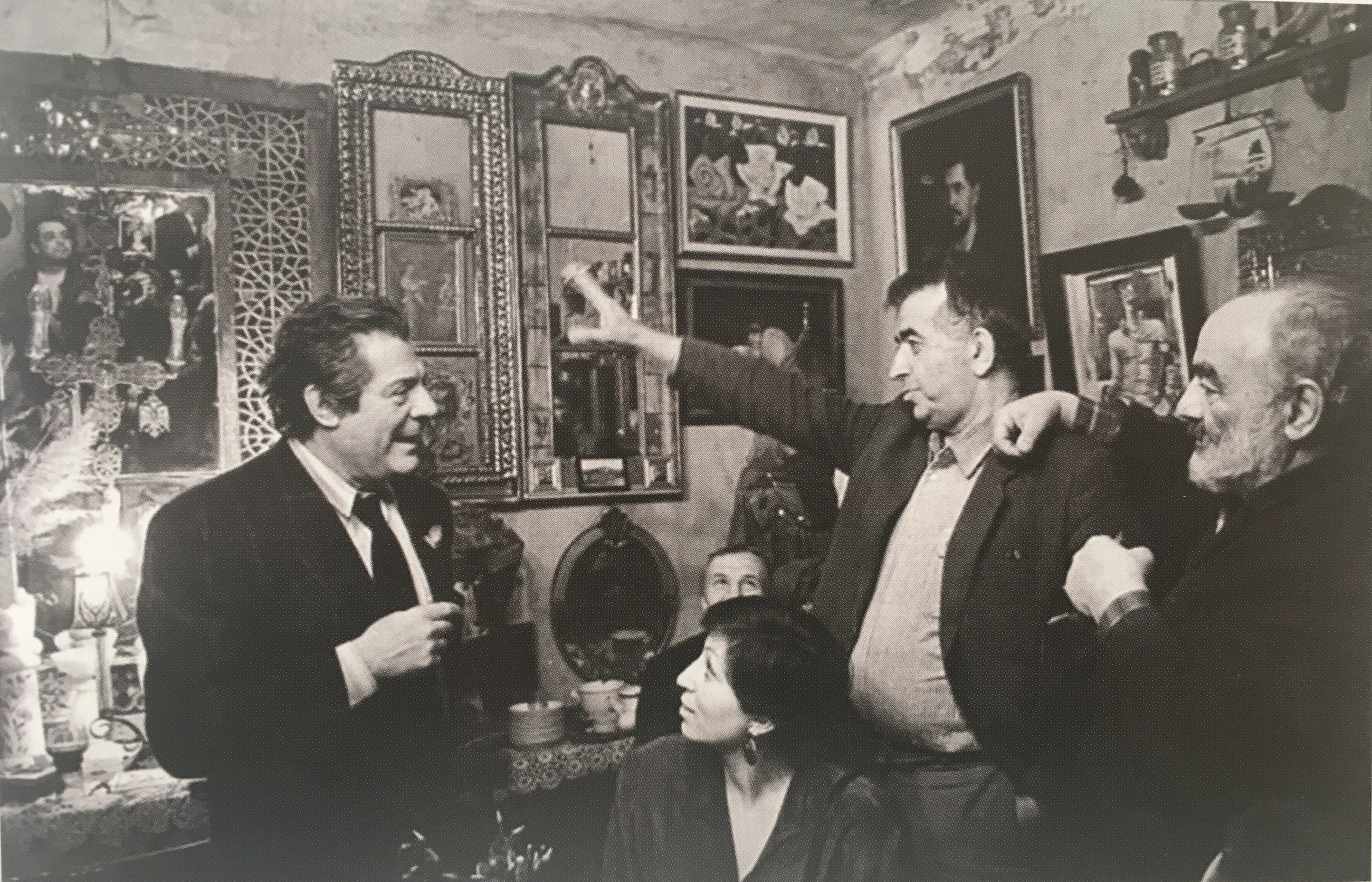
In his youth, Djorbenadze was considered Tbilisi’s “dandy number one”. All his life he was at the centre of Tbilisi’s cultural life: his closest friend was the film director Sergei Parajanov — according to an article in Doctrina, the idea of Parajanov’s “The Color of Pomegranates” was helped along by their joint trip to Armenia, and Marcello Mastroianni was among the guests at his house in old Tbilisi. Friends and colleagues remembered him as a man distinguished by intellect and refinement.
Djorbenadze was a passionate collector. On his initiative and with his funding, the Museum of 19th-Century Urban Interior was created on former Ruisi Street. This detail says a lot about his vision: for him, an interior was not a set of furniture, but a living history of an era, a character and a way of life.
According to The Calvert Journal, shortly before the palace opened, Djorbenadze told American mathematician Rolf Gross that the Soviet Union would collapse within ten years. The prophecy came true in seven.
Why Was Butsa Djorbenadze Forgotten?
Butsa Djorbenadze was forgotten for several reasons that coincided with one another.
First — the change of era. After independence was gained, everything from the Soviet period, including architecture, was often perceived as part of a past from which the country was breaking free. In this mood, even high-quality signature buildings fell into the same category as faceless standard apartment blocks.
Second — the construction vacuum. During the civil unrest and economic crisis of the 1990s, construction practically came to a halt. After losing the cathedral competition, Djorbenadze built nothing more and, according to The Calvert Journal, turned to collecting antiques.
Third — the fate of the building. For years the Palace of Rituals was a private residence and remained closed to the public. The city’s most distinctive building had, in effect, dropped out of city life.
In recent years this picture has been changing: international architectural publications, photographers and tourists are rediscovering Georgian Soviet modernism, and Butsa Djorbenadze’s name is moving to the centre of this interest.
Death and Legacy
Victor Djorbenadze died in 1999, in the midst of the post-Soviet transformations, almost entirely forgotten. He was buried at Mukhatgverdi Cemetery, in the complex built to his own design.
Over the last decade, interest in his work has grown again:
- In Avlabari, where he spent the last years of his life, former Ruisi Street now bears the name of Victor Djorbenadze;
- A collection of memoirs and materials, “Butsa — Architect Victor Djorbenadze”, has been published;
- In 2002, director Sasha Rekhviashvili made a biographical film about his life and views;
- International publications, including The Calvert Journal, call his approach “contextual monumentalism” — large-scale architecture that echoes local tradition but does not fetishize it.
The authors of The Calvert Journal article write that Djorbenadze’s designs echoed local tradition, but without fetishizing it, and that today’s architecture and development could truly benefit from a little of the “Djorbusier approach”.
Djorbenadze, Gaudí, Mies van der Rohe and Zaha Hadid
Butsa Djorbenadze’s place is easier to see if we compare him with other great names in world architecture — those we write about in this series of the CORIDOOR blog.
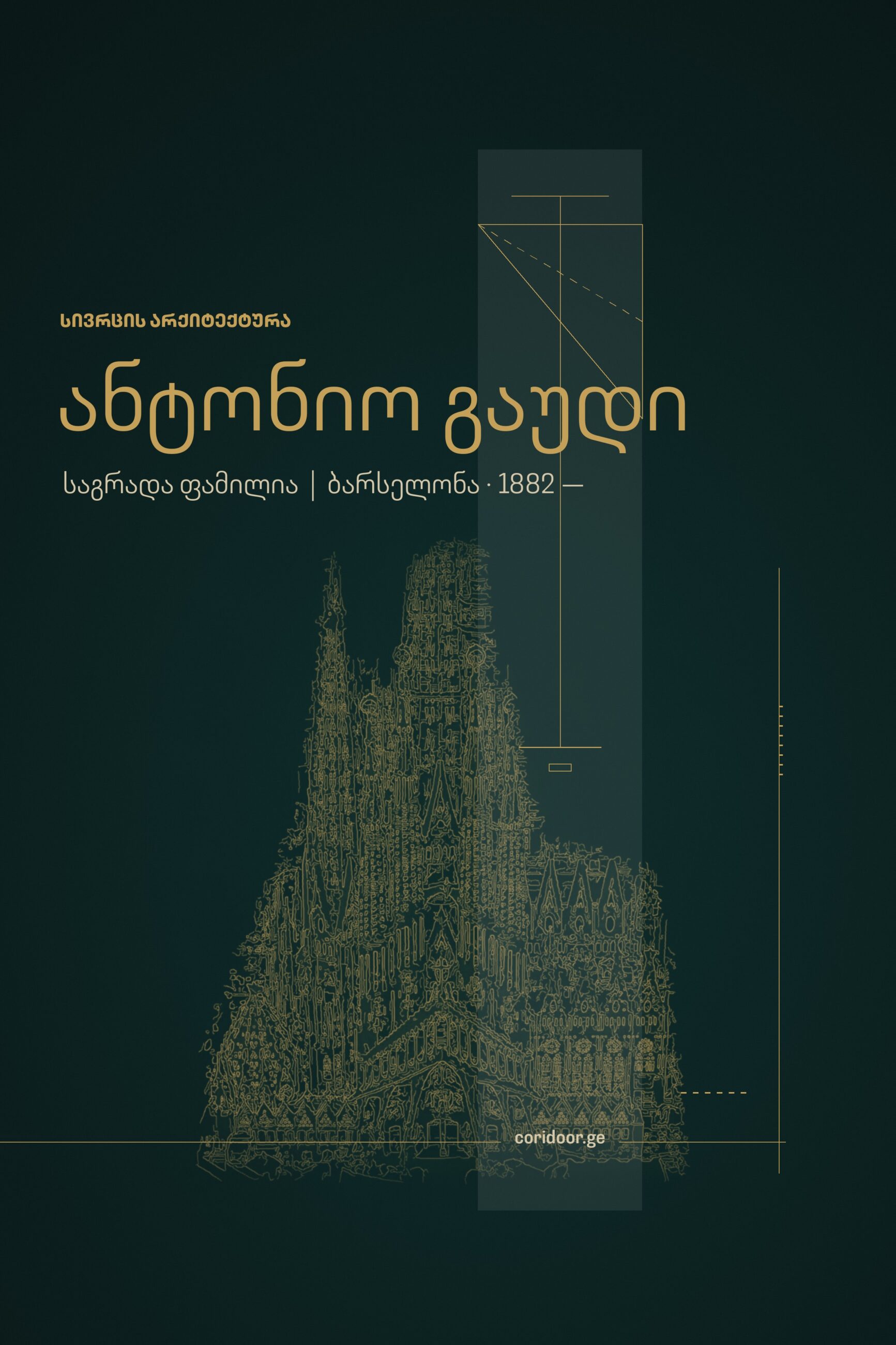
Like Antoni Gaudí, Djorbenadze designed a building down to the last detail — stained glass, metalwork and even manhole covers — as a single concept. Like Gaudí, too, church architecture was a central theme of his work.
Mies van der Rohe, on the other hand, is his complete opposite: minimalism, the right angle, the rejection of ornament. Yet they agree on one thing: material must be honest, and space must be organized for human experience.
With Zaha Hadid, Djorbenadze shares an interest in sculptural, flowing form and the perception of wall, ceiling and floor as one continuous flow. Interestingly, the best-known work of each in the region — the Palace of Rituals in Tbilisi and the Heydar Aliyev Center in Baku — is a ceremonial, public space that has become a symbol of its city.
Djorbenadze’s uniqueness lies in the fact that he did all this in a Georgian context, within the Soviet system, and translated his country’s historical memory into the language of contemporary architecture.
What Butsa Djorbenadze Teaches Us About the Contemporary Interior
1. Tradition without copying. Djorbenadze studied the Georgian church and the darbazi in depth, but never repeated them. In an interior, this means that local character can be conveyed through proportion, material and light rather than through stylized ornament.
2. Every detail is part of the concept. In Butsa Djorbenadze’s Palace of Rituals, the stained glass, the metal railing and the manhole cover all “speak” the same language. The detail an architect considers “insignificant” is precisely what makes an entire interior look cheap or expensive. A premium interior is created the same way: the door, the partition, the handle and the frame must belong to a single stylistic system.
3. Light from above. The idea of the erdo — light descending from the centre of the space — is still one of the most powerful interior techniques today. A dark corridor or a windowless room is one of the most common problems of the modern apartment. Glass partitions and doors with glass inserts solve the same task: they carry natural light deep into the space.
4. Space as a route. Djorbenadze’s spiral walls lead a person through the space, opening a new view at every step. As Socialist Modernism describes it, the palace’s interior is “in complete harmony with the human being” — despite its scale, it is created for human movement and perception. In a modern apartment, too, the placement of doors and partitions determines how a person moves and how they perceive the space.
5. Interior as history. The Museum of 19th-Century Urban Interior proves that for Djorbenadze an interior was a reflection of a way of life. A good interior tells the story of its owner’s character, and high-quality materials and well-chosen details retain their value even decades later — just like Djorbenadze’s buildings, which a new generation is discovering today.
Frequently Asked Questions About Butsa Djorbenadze
Who was Butsa Djorbenadze? Victor (Butsa) Djorbenadze (1925–1999) was a Georgian architect, the author of the Palace of Rituals in Tbilisi, the Mukhatgverdi Ritual Complex and the Ilia Chavchavadze Museum in Kvareli.
Who built the Palace of Rituals in Tbilisi? The Palace of Rituals was designed by architects Victor Djorbenadze and Vazha Orbeladze. Construction took place in 1979–1984, and the building opened in 1984, during the “Tbilisoba” festival.
Why was Djorbenadze called “Djorbusier”? Because of his admiration for the French architect Le Corbusier. Le Corbusier’s Ronchamp chapel had a particularly strong influence on him.
Where is the Palace of Rituals located? In Tbilisi, on the Avlabari side, at 21 Bochorma Street, on the high bank of the Mtkvari.
Who owned the Palace of Rituals? In 2002 the building was purchased by businessman Badri Patarkatsishvili, who used it as a residence. After his death, his heirs returned the building to the public. Today it is an events venue.
What is the main feature of Djorbenadze’s architecture? A synthesis of deep knowledge of Georgian church and residential architecture with European modernism, especially Le Corbusier’s late work. In his buildings, tradition is not quoted but rethought.
When was the Mukhatgverdi Ritual Complex built? The complex, which was Butsa Djorbenadze’s first independent project, was completed in 1974. It comprises four buildings: an office, a water tower, a stonemasons’ workshop and a ritual hall.
What is “contextual monumentalism”? This is what the authors of The Calvert Journal call Butsa Djorbenadze’s approach: large-scale, monumental architecture that echoes the history and tradition of a place, but falls neither into nostalgic imitation nor into standardized modernism detached from its place.
Can the interior of the Palace of Rituals be visited? The palace operates as an events venue, and tourist tours are also held there. The possibility of visiting the interior depends on the schedule, so it is essential to confirm the conditions before your visit.
Where is Victor Djorbenadze buried? In Tbilisi, at Mukhatgverdi Cemetery — in the ritual complex he designed himself.
CORIDOOR’s showroom in Batumi presents doors, glass partitions and hardware in which Djorbenadze’s principle — every detail is part of a single concept — is translated into the language of the contemporary interior. Visit us and see how detail creates the character of a space.
Sources
- National Library — Biographical Dictionary: Butsa Djorbenadze
- Wikipedia — Victor Djorbenadze
- Wikipedia — Wedding Palace (Tbilisi)
- The Calvert Journal / New East Archive — Soviet po-mo: Georgia’s forgotten master architect
- Socialist Modernism — The Palace of Rituals (Tbilisi)
- Architectuul — Victor Djorbenadze
- Graves of Good Georgians — Victor Djorbenadze
- Home is — The Giant Architect of Our Era — Butsa Djorbenadze
- Doctrina — A Forgotten Georgian Architect and the History of the Palace of Rituals